
Our latest manuscript using hybrid superconducting circuits to probe van der Waals quantum materials is out! You can view the arXiv pre-print here.
This work was led by Yejin Lee and Haolin Jin from our group, in collaboration with colleagues at the MPI-CPfS, IFW Dresden, and Cornell University.
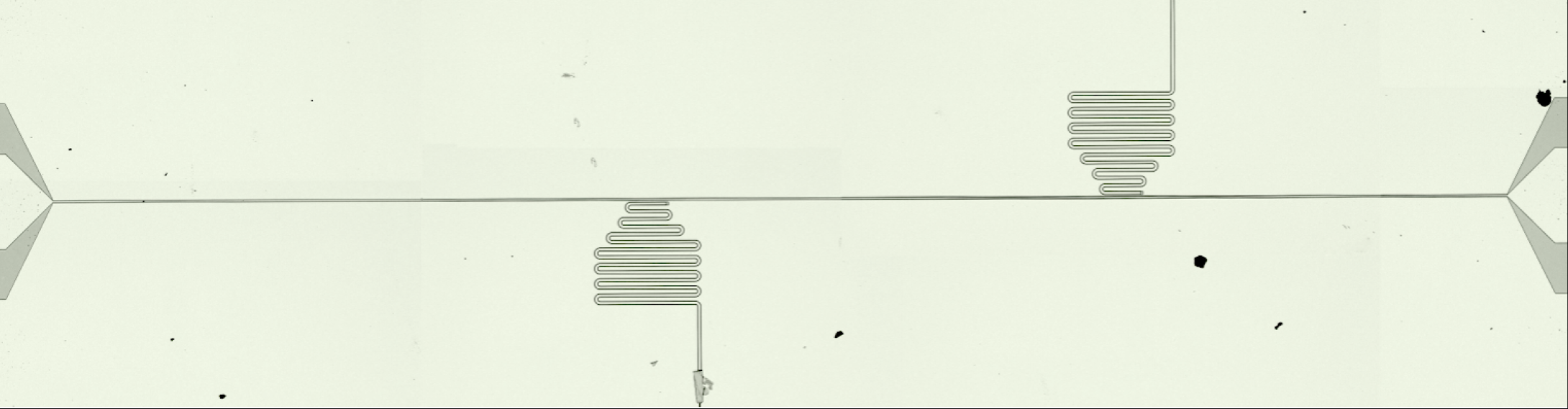
In this work, we use superconducting microwave resonators to probe the superconducting gap structure of the van der Waals kagome superconductor CsV₃Sb₅. Determining the gap structure is an important clue to understanding the origin of superconductivity in this fascinating material, but conventional probes become increasingly difficult to apply to small and delicate exfoliated flakes. Instead, we integrate the flake directly into a microwave resonator, where changes in its superfluid density modify the resonance frequency and can be measured with very high sensitivity.
Our hybrid circuit design does not have any galvanic contact, relying purely on capacitive coupling. This significantly simplifies the integration of exotic materials into circuits, but comes at the cost of parasitic two-level-system defects at the interfaces affecting the measurement. By systematically changing the geometry of the hybrid device, we show that these unwanted contributions can be strongly suppressed, allowing us to access the intrinsic electrodynamic response of the CsV₃Sb₅ flake. At low temperatures, we find that the superfluid density varies linearly with temperature, providing evidence for low-energy quasiparticle excitations and a nodal superconducting gap.
Beyond the specific result for CsV₃Sb₅, this work demonstrates how hybrid superconducting circuits are a versatile platform for integrating quantum materials with coherent devices. By engineering the circuit geometry, we can control the interaction between the material and the microwave mode while maintaining a high-quality quantum circuit. These capabilities open opportunities both for exploring the properties of unconventional quantum materials and for using these materials as functional elements in new quantum devices.
Congratulations and many thanks to everyone who contributed!
