
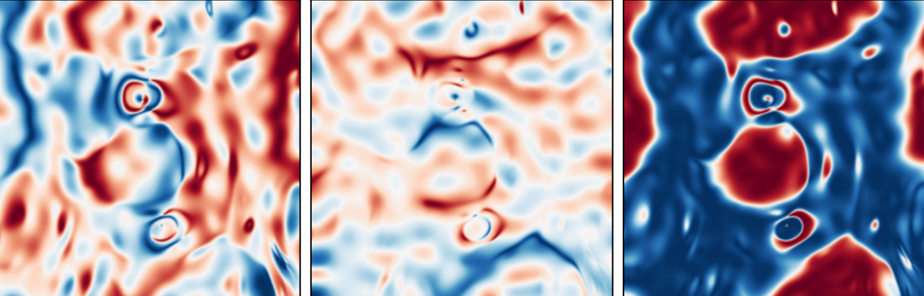
Our manuscript presenting a new reconstruction technique for magnetic textures is out! You can view the arXiv pre-print here.
This great collaboration between theorists and experimentalists was led by Claas Abert’s group at the University of Vienna. Our group’s Nitrogen-Vacancy microscopes at the MPI-CPfS performed the experimental data and analysis. Special congratulations to Alex Setescak, who developed the algorithm, and to Young-Gwan, Hayden, and Lotte from our group!
The work addresses the “inverse” reconstruction problem, in which the magnetization texture of a material is reconstructed based on measurements of a stray magnetic field above the sample. Direct reconstruction is challenging because various magnetizations lead to identical stray field maps, and experimental imperfections, such as a finite height above the sample and a limited measurement area, can be detrimental. Instead, we use a “physics-informed” reconstruction, combining an optimization algorithm with a micromagnetic simulation of the material. This method ensures that the solution matches the measured magnetic field and represents a stable state of the magnetic material. This method efficiently finds the likely magnetization and helps overcome experimental imperfections. We tested the algorithm on synthetic data as well as on magnetic textures of van der Waals ferromagnet Fe₃GaTe₂ flakes, which we measured using NV magnetometry.
Congratulations and big thanks to everyone who participated!
Stay tuned for additional announcements detailing our findings from these fascinating magnetic structures.
